Frankfurt, July 15, 2026. Internet-based reception methods, smart TV interfaces, and streaming services are continuously changing the technical framework conditions for television use. The AGF Platform Study has documented these developments for many years and provides important insights that contribute to defining the external parameters of the AGF system. With the spring wave of 2026, the study was expanded for the first time to include questions on the user journey on the TV device. This complements the technical findings of the Platform Study with a behavioral perspective and enables a systematic analysis of how viewers access linear and non-linear video content offerings under today’s technical conditions.
The new questions close an important gap between technical equipment and actual usage behavior. They show not only which technical options are currently available to viewers, but also which access paths they actually choose and how these differ across generations. Going forward, the Platform Study will therefore make an even greater contribution to understanding structural changes in video consumption and assessing their impact on the use of the television set.
Getting started with TV usage remains predominantly direct
With the new questions, AGF is examining for the first time how viewers access video content offerings after switching on their television set. The results show that, despite increasing technological diversity, the start of TV usage remains direct for most households. When asked to turn on the TV, 96.8 percent use the classic remote control. Smartphone apps (1.0 percent) and voice control (0.6 percent) currently play only a minor role.
In more than two-thirds of households (68.2 percent), the current TV programme appears immediately after switching on, while 29.6 percent are taken to a user interface. Compared with previous waves, this ratio remains stable. Access to the current programme – whether directly after switching on or via the user interface – is predominantly through the last channel watched (75.1 percent). 10.3 percent of households start with a predefined default channel, while another 10.3 percent initially access a channel overview. The first channel most frequently viewed is ARD Das Erste (35.6 percent), followed by ZDF (14.5 percent) and RTL (10.7 percent).
At the same time, channel organisation presents a balanced picture: Half of all households (50.0 percent) have customised their channel list or created a favourites list, while 45.7 percent continue to use the factory default channel order. The results show that while technical access paths continue to evolve, the immediate entry into the TV programme remains the starting point for video consumption in the majority of households.
Smart TV interfaces are becoming the central access point for video content offerings
With the increasing spread of internet-enabled TV devices, smart TV interfaces are becoming increasingly important for accessing video content offerings. 57.7 percent of TV households now have a smart TV user interface. A further 33.3 percent own an internet-enabled television set but do not have a smart TV interface. This means that the vast majority of TV households now have additional options for selecting content directly via a user interface.
For the first time, the Platform Study also examined which functions these user interfaces provide to viewers immediately after switching on their TV set. 86.7 percent of smart TV interfaces offer at least one of the navigation functions surveyed. The most common feature is an overview of installed apps (53.4 percent), followed by content recommendations (29.9 percent) and the option to immediately resume content that has already been started (21.3 percent). 13.1 percent of user interfaces also provide direct access to the current TV programme. These findings show that smart TV interfaces today are far more than just a technical start menu. They bring together different access paths to video content offerings and support orientation on the big screen.
The applications immediately visible on the interface also illustrate the diversity of available offerings. Netflix is the most frequently visible app on the user interface (47.4 percent), followed by YouTube (41.9 percent) and Prime Video (41.8 percent). The services of TV broadcasters are also present: the ARD Mediathek is directly visible on 36.7 percent of smart TV interfaces, while the ZDF streaming portal appears on 32.2 percent. Overall, at least one video streaming app is directly available on the home screen of 52.8 percent of households with a smart TV interface. Smart TV interfaces therefore bring together offerings from different providers on a shared navigation level and create additional opportunities to switch between linear and non-linear video content offerings.
In addition, the study examined for the first time the extent to which users customise their user interfaces. 35.1 percent of people with an app overview have already changed the order of apps themselves or arranged them individually. For a further 26.4 percent, the sorting is automatically based on previous usage behaviour. Accordingly, satisfaction levels are high: 87.6 percent rate the displayed selection and arrangement of apps as very good or largely suitable for their personal needs. Smart TV interfaces are therefore increasingly developing into a personalised orientation layer on the television set.
Remote controls are evolving into a central interface for different access paths
The Platform Study also provides a comprehensive analysis of the role the remote control plays in accessing video content offerings. The results show that its function has changed significantly in recent years. While traditional control elements remain an integral part of TV usage, direct access options to streaming services are becoming increasingly important. Colour buttons are still available on the majority of remote controls (84.1 percent), but their actual use continues to decline. Only 31.1 percent of respondents actively use the available colour buttons, while 53.0 percent have the corresponding buttons but do not use them. Compared with the previous wave, this trend continues (2025 II: usage 39.7 percent, not used 45.8 percent).
In contrast, platform buttons have now become standard equipment for many households. 54.0 percent of respondents have at least one direct access button for streaming or online services – a significant increase compared with the previous wave (46.7 percent). The most common is a Netflix button (52.3 percent), followed by Prime Video (39.9 percent), YouTube (28.0 percent) and Disney+ (26.1 percent). Looking only at remote controls that have at least one platform button, 96.9 percent include a Netflix button (2025 II: 92.5 percent).
The extent to which remote controls are equipped with platform buttons is closely linked to the age of the television set. Among devices that are no more than two years old, 74.6 percent of respondents have a Netflix button. For television sets older than ten years, this applies to only 13.9 percent. A comparable pattern can be observed across almost all platforms: the newer the television set, the more frequently direct access to streaming services is part of the standard equipment.
However, technical availability alone does not determine usage behaviour. 56.2 percent of respondents use platform buttons at least occasionally. While occasional use remains almost unchanged compared with the previous wave, the share of frequent use has declined slightly.
Access to broadcaster services is also changing. 32.4 percent of the population aged 14 and over use media libraries on their TV set. At the same time, access is increasingly shifting from the traditional Red Button to internet-based user interfaces. While 41.4 percent of users access media libraries via the Red Button (2025 I: 47.7 percent), 59.5 percent access them via internet menus or app tiles (2025 I: 52.2 percent). The results show that internet-based access paths are becoming increasingly established and are complementing existing navigation options.
User Journey: The TV programme remains the primary access point to video content for the majority
With the spring wave of 2026, the Platform Study was expanded for the first time to include questions on the user journey. This now makes it possible to understand which paths viewers actually choose after switching on their television set and how these differ between generations.
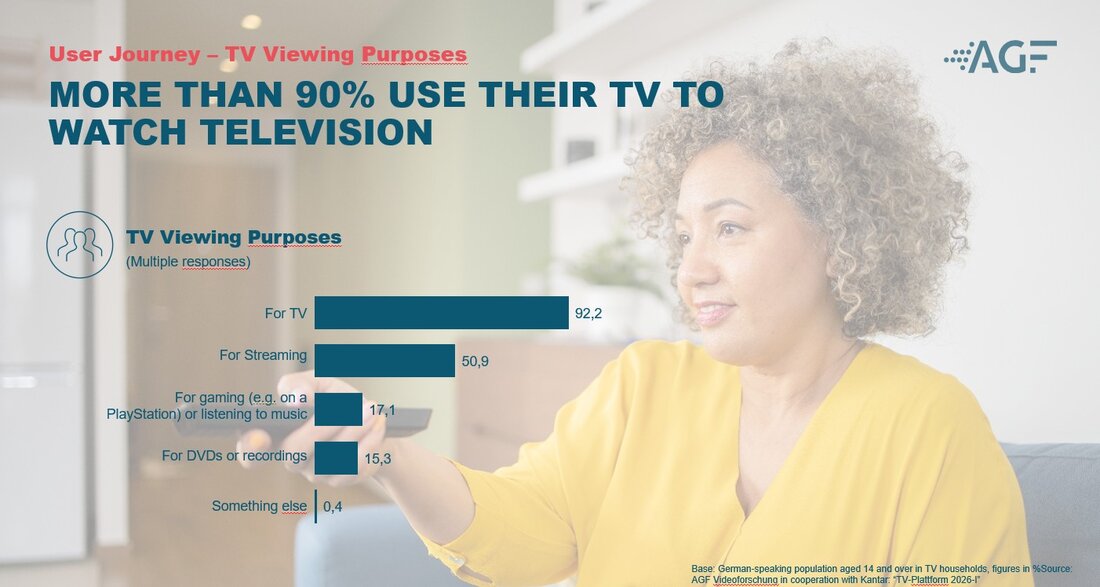
The results highlight the continued importance of the television set as the central screen for video content offerings. 92.2 percent of respondents use their TV set for watching television, while 50.9 percent also use it for streaming. In addition, the television set is used for gaming or listening to music (17.1 percent) as well as for watching recordings or DVDs (15.3 percent). The TV set therefore combines different forms of use on a single screen.
Looking at the first step of video usage, the path for the majority of viewers still leads initially to the TV programme. 79.2 percent state that, after switching on their television, they usually use the current TV programme first. For 26.8 percent, TV usage also begins directly with a streaming service. Opening a media library or a broadcaster’s streaming portal (12.3 percent) or YouTube (8.7 percent) currently plays a significantly smaller role as an entry point.
Clear differences can be seen between generations. While 96.9 percent of those aged 65 and over usually begin their video usage with the classic TV programme, this share is 64.3 percent among 14- to 29-year-olds. At the same time, 48.6 percent of 14- to 29-year-olds also generally start with a streaming service, compared with only 4.2 percent among those aged 65 and over. This demonstrates that navigation patterns on the TV set differ significantly between generations. However, for the majority of the population, the TV programme remains the first access point to video content offerings.
In linear television, programme search remains flexible
The new questions in the Platform Study also provide, for the first time, insights into how viewers make their programme selections in linear television and which alternatives they choose when the current offering does not meet their expectations.
If the current TV programme initially does not show suitable content, linear television remains the preferred orientation space for the majority of viewers. 55.4 percent state that, in most cases, they continue channel surfing. Much less frequently, typical usage behaviour includes switching off the television set (19.9 percent) or switching directly to a streaming service (15.4 percent) or a TV media library (11.1 percent).
Here too, clear differences can be seen between generations. While 65.7 percent of those aged 65 and over continue browsing through the linear TV programme at least occasionally, this applies to 48.1 percent of 14- to 29-year-olds. Conversely, 26.1 percent of younger viewers sometimes switch to a streaming service in this situation, compared with only 5.7 percent of those aged 65 and over. The results show that younger target groups switch more frequently between different types of offerings, while older viewers search more strongly within the linear TV programme for suitable content.
There is also no dominant access path when selecting a specific programme. 47.1 percent generally select programmes by continuing to browse through the channels. 46.8 percent primarily use a programme overview, such as a TV guide, an electronic programme guide (EPG) or a TV app. 36.6 percent prefer to rely on established favourite programmes. Accessing linear TV offerings via TV guides or EPGs also shows age-specific differences: Almost two-thirds of older viewers (64.9%) compared with 35.4% of younger viewers use information sources to make a conscious programme selection. Overall, this shows that orientation within linear television depends on the situation and that different information sources are combined.
Recommendations and targeted searches shape the selection of streaming content
For streaming services as well, the current wave of the study systematically examined for the first time how viewers find their way to content and how they proceed when they do not immediately discover a suitable offering. When TV usage begins with a streaming service, Netflix is the first point of contact for 16.0 percent of all respondents. YouTube (5.7 percent) and Prime Video (4.0 percent) follow by a considerable margin. This preference is particularly pronounced among 14- to 29-year-olds: In this age group, 30.9 percent initially start with Netflix, while the share among those aged 65 and over is 3.4 percent.
If no suitable content is found on the platform accessed first, most users initially continue their search within the same service. This approach generally applies to 17.1 percent. Less frequently, users switch directly to another streaming service (11.6 percent) or move to the linear TV programme (7.7 percent).
Both recommendations and targeted searches play an important role in selecting specific content. 22.7 percent rely on recommendations on the home page of a streaming service, while 22.4 percent specifically search for a particular title. This indicates that viewers use different paths to find suitable content both in linear television and on streaming services. The preferred access paths vary depending on the type of offering and the usage situation.
New perspectives on navigation in a diverse video content landscape
With the expansion of the Platform Study, AGF is combining, for the first time, the technical framework conditions of video usage with the actual navigation behaviour of viewers. The study shows that, despite a continuously growing variety of offerings and access paths, the TV set remains the central starting point for video consumption. At the same time, it becomes clear that orientation on the TV set is becoming increasingly differentiated. Linear television, streaming services, media libraries and smart TV interfaces now exist side by side on an equal footing and provide different paths to the desired content.
The Platform Study therefore expands its previous focus on the technical equipment and usage of video households by adding a behavioural perspective. For the first time, it provides insights into how viewers access video content offerings under today’s technical conditions and what role different access paths play.
“The Platform Study has been providing important information on the technical framework conditions of video usage for many years and thus represents a key component in determining the external parameters of the AGF system. With the current expansion, we are complementing this perspective for the first time with insights into viewers’ navigation behaviour on the TV set. This enables us to better assess technical developments and their impact on usage in the future. At the same time, the results show that the paths to video content offerings are becoming increasingly diverse, while the TV set remains the common starting point for video consumption,” explains Kerstin Niederauer-Kopf, CEO of the AGF.
Methodological profile
For the Platform Study, the market research institute Kantar, commissioned by AGF Videoforschung, surveys the German-speaking population aged 14 and over in TV households twice a year using personal CAPI interviews. In addition, the television sets available in households are inspected on site, and selected TV programmes and streaming services are accessed together with the respondents.
Wave 2026 I
• Fieldwork period: February 16 to April 13, 2026
• Sample: 2,517 interviews, including 2,358 in TV households (159 in non-TV households)
• Sample: Proportional, representative random sample based on the ADM face-to-face sampling system
With the spring wave of 2026, the questionnaire for the Platform Study was expanded to include new topic areas covering smart TV usage and orientation on the TV set. For the first time, questions were included on viewers’ navigation behaviour when accessing linear and non-linear video content offerings.
Unless otherwise stated, all results refer to the spring wave of 2026. Comparison values from previous surveys are indicated accordingly.